


Co-written by Sarah Macleish & Rebecca Cort
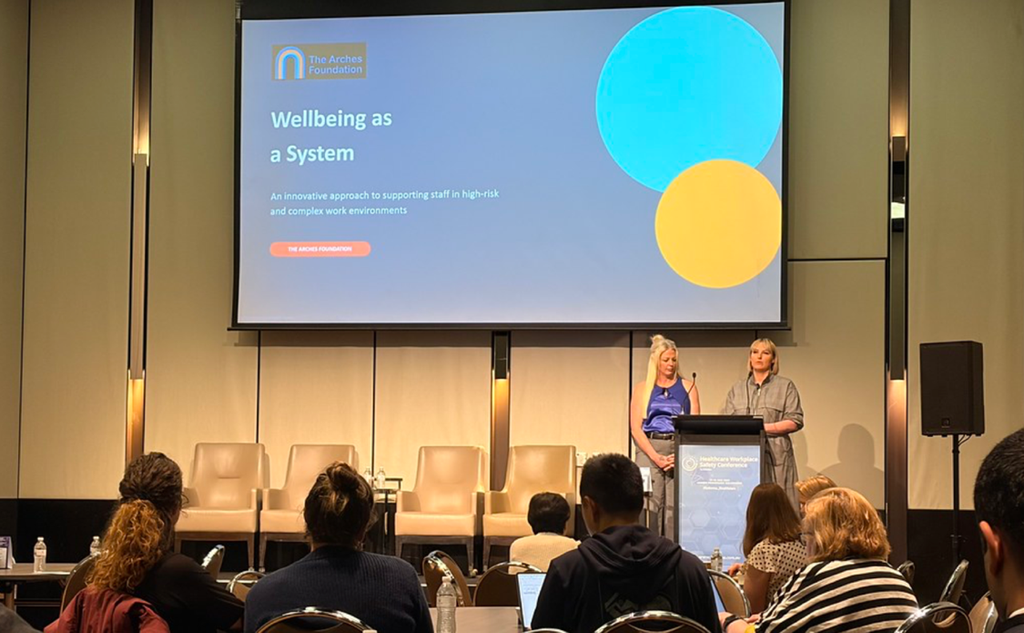
Recently, Sarah Macleish and Rebecca Cort from The Arches Foundation had the opportunity to present at the National Healthcare Workplace Safety Conference in Melbourne on “Wellbeing as a system: an innovative approach to supporting staff in high-risk and complex work environments.” The conference brought together leaders from across healthcare and social assistance to examine occupational violence, psychosocial risk, psychological injury and workforce sustainability.
Our presentation centred on a simple premise: if staff are the primary conduit through which care is delivered, their wellbeing and safety cannot be treated as optional extras.
At The Arches Foundation, our workforce supports young people and families whose needs are often complex, interconnected and not easily met through traditional interventions. Staff may be responding to aggression, suicidal ideation, trauma, relational rupture and issues intersecting with health, justice and domestic and family violence. This requires them to remain regulated, relational and therapeutically responsive—often in highly volatile circumstances.
In this context, workplace safety must extend beyond protection from physical injury. It must also include emotional and psychological safety: the conditions that allow staff to seek support early, reflect honestly, recover following critical incidents and continue working without cumulative stress eroding their capacity to connect and care.
Moving beyond reliance on EAP
Employee Assistance Programs remain an important component of workplace support, but our experience—and the wider evidence—shows that simply having an EAP does not mean staff can access, trust or meaningfully benefit from it.
Traditional EAP models are generally external, episodic and activated after an employee has reached a point of distress. They may also lack a deep understanding of the specific work environment, the client group and the relational and therapeutic demands being placed on staff. Concerns about confidentiality, limited continuity and the effort required to explain the complexity of the work can create further barriers to engagement.

For Arches, it became clear that an EAP could not be the primary wellbeing response. Staff working in high-risk environments need support that is visible, trusted, responsive and connected to the realities of their daily work.

Wellbeing embedded in the Arches Practice Framework
This led us to position wellbeing within the Arches Practice Framework rather than treating it as a separate program or collection of staff benefits.

The Arches Practice Framework connects organisational culture, leadership, workforce capability, therapeutic practice and client outcomes. It recognises that trauma-informed care cannot be sustained through frontline skills alone. The organisation must create the conditions that enable staff to apply those skills consistently—particularly when the work becomes difficult.
Within this framework, wellbeing is understood as essential practice infrastructure. Supervision, reflective practice, training, psychosocial risk management, post-incident support and workforce data are connected as parts of one system. This allows us to move beyond reacting to individual distress and instead identify the organisational, relational and operational conditions contributing to it.
The focus shifts from asking, “How can this employee become more resilient?” to also asking, “What is happening within the work, the team and the wider system—and what needs to change?”
Building a dedicated internal Wellbeing Team
A key point of difference has been the creation of a dedicated internal Wellbeing Team. The team was intentionally developed to provide high-quality support grounded in a deep understanding of Arches’ operating environment.
Team capability includes Psychological First Aid, narrative practice, trauma-informed practice, PACE and Therapeutic Crisis Intervention. This enables the team to recognise emerging distress, respond following critical incidents, support reflection and relational repair, and connect staff wellbeing directly to therapeutic practice.
Because the team understands the work, staff do not need to spend valuable time explaining its context or complexity before meaningful support can begin. Support can be individual, team-based or responsive to the needs of a particular client or situation. Importantly, the team is positioned as a trusted and accessible part of organisational practice—not a distant service activated only once something has gone wrong.
Meaningful staff engagement provides evidence that this model is reaching the workforce. Our evaluation has included more than 1,450 Professional Quality of Life assessments and 287 Caregiving and Compassion Questionnaire administrations. The data has helped identify relational strain that traditional wellbeing measures alone did not detect, enabling more targeted support, reflection and organisational action.

This is where measurement becomes meaningful: not when data is simply collected, but when it changes the response.

Safety as a shared organisational responsibility
Our key message at the conference was that wellbeing must be designed into the work. No single intervention—even a strong internal team—can carry responsibility for workforce safety in isolation.
Leadership behaviour, workload, supervision, team culture, psychological safety, post-incident responses and access to trusted support all shape whether staff can remain safe and effective. The innovation is not any one service; it is the connection between them.
When organisations create the conditions for people to feel physically safe, emotionally supported and psychologically protected, they strengthen more than workforce wellbeing. They also build the capacity for consistent, relational and trauma-informed practice—and ultimately, better outcomes for the people their workforce supports.


